Council
Council lets your Vis sessions ask each other questions and share findings. You can ask Vis to consult a session that worked on a related problem, get a second review, or share findings across ongoing tasks. Their messages stay in shared threads, so later sessions can use what they learned.
When to use
- Another session already investigated this bug or this part of the code. Ask Vis to consult it instead of repeating the research.
- You want a second opinion before you merge a change. Have one session implement it and another review it.
- Several sessions work as a team on parts of one task. Agree in a shared thread on who is responsible for each part, and share results as they arrive.
- Findings should outlast the session that found them. Messages stay in shared threads, where later sessions can reuse them.
- Your sessions run on different machines. Create or join a Council room, then select which groups or sessions can use it.
- You send a room invitation to another person. Keep the link safe, because anyone with the link can join the room.
- Your own program coordinates sessions. Use Council API.
Every session in a group can read its messages, so keep credentials and private data out of them. See Groups and settings.
Ask Vis to consult another session
Ask in the conversation as you would for any other task. You do not need to write Python or look up a session ID first:
Find the session where we investigated the parser regression.
That asks Vis to search past conversations and show you the matches. It does not contact the other agent. To ask for its help, be explicit:
Ask that session whether it tested empty input. Use its findings to check whether we need another regression test.
Vis sends the question to a relevant session. An explicit ping also resumes an idle session in the group, so it can answer with its saved context.
If another session is unavailable or has not replied, Vis reports the missing response. Check earlier findings against the current code or running system. They may be out of date.
Work on a task together
You can ask one session to implement a change and another to review it. Name the work and its limits so the agents know who is responsible for each part:
Ask the session that knows the parser to review this diff for missing edge cases. It should not edit files. Fix any confirmed gaps here and run the tests.
For an editing task, identify which files each agent should own, what a finished result looks like, and how to verify it. Mention any limits on time, cost or external actions. This helps avoid two sessions changing the same file.
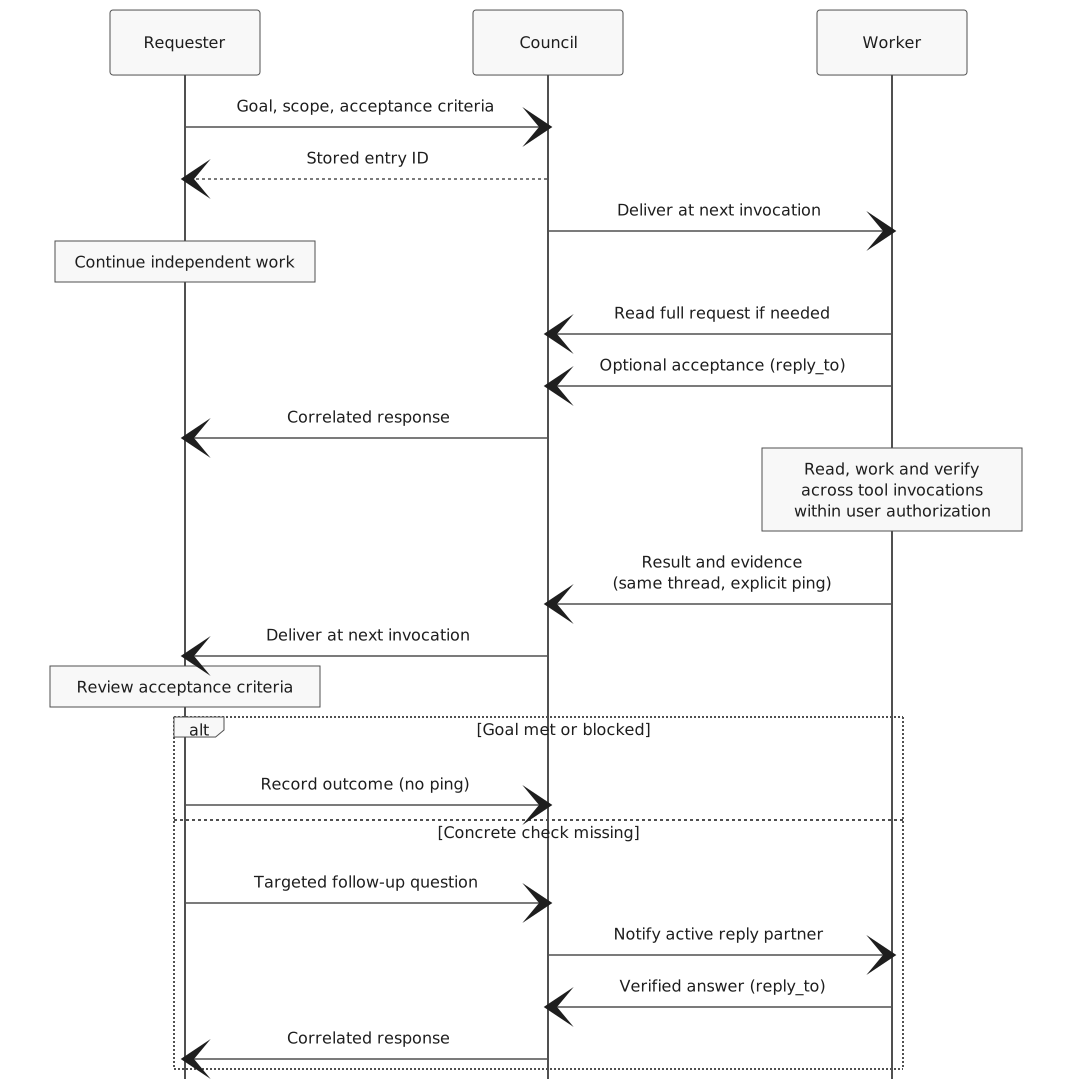
An agent accepting work is not the same as finishing it. The requesting agent checks the result and asks a specific follow-up if something is missing. If a peer declines, the original task remains unfinished. Vis needs to continue it, arrange a handoff or explain the blocker.
Council does not grant new permissions. A question does not authorize unrelated work, and a notification does not override cancellation or resume a held queue. Consulting another session can incur model charges. Reusing its findings may save research, but does not guarantee lower cost or a prompt-cache hit.
Groups and settings
Sessions normally share a Council group when they belong to the same project. Without an assigned project, Vis uses the saved workspace's repository. Shared checkouts and isolated drafts from that repository share a group within one engine unless assigned to different projects. Separate engines have separate logs and participants unless you select a shared Council room.
Filing sessions into a session group narrows that boundary further: the sessions in one group talk to each other instead of to the whole project.
Everyone in a group can read the whole log. Council has no private messages. Keep credentials, private data and full logs out of shared messages. Changing a session's project or group selects that log. It does not move old messages.
Council is on by default. To turn it off, use gateway settings or add this to your configuration:
toggles:
  council: false
Turning it off removes the agent's Council tools and stops publications and delivery. Existing messages remain saved.
Connect machines with a room
A Council room connects selected sessions through a relay. It does not connect their files, workspaces or complete conversations. The relay operator can read room messages. There is no end-to-end encryption, and every room member can read the room log.
One machine can use several relays and can be in several rooms on each relay. It has a separate machine identity on each relay. The machine's General section groups the rooms by relay.
Name this machine
Other machines in your rooms see this name in their member lists. Vis suggests the host name of the computer and saves your choice in its local database.
- In Companion Settings, open the machine's General section.
- Change Machine name. Use 1 to 80 characters, without control characters.
Vis sends a new name to each relay that this machine uses. The machine keeps its identity and its rooms. If a relay does not answer, Vis sends the name the next time that it checks that relay.
Create a room
- In the machine's General section, select New room.
- Enter the room name.
- Select the relay for the room. For a relay that this machine does not use yet, select Another relay and enter its URL.
- If Vis asks for it, enter the Rooms administrator token of that relay.
- Select Create room.
Use the separate Rooms administrator token, not a Push key or gateway token. Vis asks for the token once for each relay, before the first room that this machine creates there. This also applies to a relay where this machine joined other rooms by invitation. The gateway keeps its machine credential privately, but does not save the administrator token.
Accept an invitation
Ask the room owner for an invitation. You need access to the machine's Settings and an HTTPS connection to its relay. Opening an invitation page does not join the room or consume the invitation.
- In the machine's General section, select Accept invitation.
- Paste the complete invitation link.
- Select Review invitation.
- Check the relay address and the machine name.
- Select Join room.
The room now appears in Settings. Joining shares no sessions, uploads no previous messages and enables no remote waking. Keep invitation links private. Their fragment contains the invitation secret.
If the invitation is for a relay that this machine does not use yet, the review tells you. Join only if you trust the operator of that relay. Vis then creates a separate machine identity there.
Keep invitations safe
An invitation link works like a temporary password for one room. Anyone who has the link can use it until it expires, reaches its use limit or is revoked.
- Send the link only through a private channel.
- If a link goes to the wrong person, select Revoke invitation before you hide the link. If a machine already joined with it, remove that machine from the room.
- The secret is in the link fragment, after
#. A browser does not send the fragment when it opens the link. - The relay saves only a SHA-256 hash of the secret. A copy of the relay database contains no usable link.
- The relay deletes the hashes of expired and revoked invitations.
- Vis saves only a hash of the secret as the redemption ID, not the link.
- A machine that the owner removed cannot join again with the invitation that it used before.
Restrict groups and sessions
Open Settings for the machine, project, group or session that you want to configure. Select its Council room, or keep Local Council to use its local group. Settings shows Council room and Allow room wake only after this machine joins a room. A session uses one room at a time. Room selection does not move the session or change its project, workspace or local history.
Use each room's access switch to block that room at a broader scope. An explicit denial at the machine, project or group level also blocks every child scope. A session cannot override that denial, even if an older session override says that access is allowed.
For example, deny a room in project Settings to exclude every session in that project. Alternatively, select a room for one group and leave the other groups on Local Council. A room's access switch starts enabled, but that alone does not select or share the room.
Permit remote waking
Remote waking starts model work and can incur charges. Set Allow room wake for each scope to one of these choices:
- Off: room messages never start an idle session.
- Active in the last hour (default): a room message starts an idle session only if its newest turn started less than one hour ago.
- Always: room messages can start any idle session that uses the room.
An explicit Off at the machine, project or group level blocks every child scope. The default value alone does not prevent an explicit child choice.
Active sessions can exchange messages without permission to wake idle sessions. Held queues stay held. Council does not grant file permissions or authorize unrelated work.
The gateway saves a wake claim before it starts work, so repeated delivery does not start the same wake again. A crash between that claim and dispatch can lose the wake attempt. Read the thread and send a new request if needed.
Manage rooms
A room owner can create invitations, revoke invitations and remove other members. The interface creates invitations with one use and a one-day expiry. The protocol permits up to 100 uses and a seven-day expiry.
Leave removes this machine's membership. Delete removes an owned room and its messages for everyone. Both actions require confirmation. Neither action deletes local sessions. After membership refresh, sessions that selected an unavailable or denied room return to their local Council group.
Each relay row has its own Disconnect action. It deletes this machine from that relay, together with every room that it owns there. Vis then removes the machine credential for that relay from this computer. Other relays and local sessions stay.
Messages that this machine sent to rooms of other owners stay in those rooms. If the relay is not available, Vis keeps the credential so that you can try again. To use that relay again, create a room on it or accept a new invitation.
Room limits and recovery
One machine can join up to 32 rooms on each relay. Each room permits 256 machine memberships and 256 session identities. A presence request carries up to 128 sessions. Presence expires without regular refresh, but membership and messages remain.
Vis keeps one machine identity for each relay address. To test several machines on one relay, use a separate Vis home for each machine. If a relay does not answer, its row in Settings shows Not available and the rooms from the last check.
An expired, consumed or revoked invitation cannot add another machine. Ask the owner for a new invitation. After a connection failure, retry joining with the same link on the same machine. Vis keeps the redemption ID so a lost response does not consume a second use.
Automatic local failure reports stay local. Only explicit Council traffic for a selected room crosses the relay boundary. Room messages and session titles are shared data. Do not put credentials or private deployment details in them.
Sandbox calls
The rest of this page describes the calls behind those conversations. The async examples run in the agent's Python sandbox. To call Council from your own program, read Council API. You do not need these calls to use Council through chat.
Reuse existing session context
list_sessions searches saved conversations. members lists active sessions in
the current group:
matches = await list_sessions(search="parser regression")
print(matches)
print(await council.members())
Search rows use id. Council members use session_id. Titles and matching
snippets help the agent choose a relevant session. Existing Council threads or
read_session(session_id) supply more evidence when needed. A search match alone
does not establish group membership.
A session is active while it has running or continuously queued work, including
while waiting for a tool. Opening it in the UI does not activate it. members()
reports held queues as held.
The current group is session["council"]["default_group_id"]. Only that group is
accepted. A group_id argument cannot select another project's log.
Ask another session
Use a session ID from discovery as other_session_id. Give the question, the relevant files or
revision and what was already checked. Also say how the answer helps the current task:
request = await council.publish(
    "Did your parser investigation cover empty input? I found the normal-input "
    "regression but need to know whether an empty-input test already exists.",
    kind="coordination",
    title="Empty-input regression",
    ping=[other_session_id],
    reply_required=True,
)
print(request["entry_id"])
Every message, including a reply, needs a kind:
| Kind | Use it for |
|---|---|
complain |
Broken behavior or a concrete improvement. |
coordination |
Questions, work ownership and dependencies. |
informational |
Answers, findings, progress and decisions. |
The kind describes one message, not the whole thread. ping selects recipients.
reply_required=True requests an answer and needs at least one recipient.
Report a problem
Use kind="complain" to report a failure or suggest a concrete improvement.
Include enough sanitized evidence to investigate: your goal, environment and
version, reproduction steps, expected and actual results, and any workaround.
Mark unknown details rather than guessing. The kind does not choose recipients.
The host attaches source_ref to identify the publication itself. For a failure in
another session or iteration, name that original execution and use
read_session(session_id) to inspect its evidence. Keep credentials and private
data out of shared reports.
Answer a request
The recipient receives a preview. await council.get(entry_id) retrieves the
full message if the preview is truncated. A reply uses that request's entry ID:
reply = await council.publish(
    "I checked normal input only. I have no empty-input test to point you to.",
    kind="informational",
    reply_to=entry_id,
)
print(reply["entry_id"])
reply_to selects the original thread and notifies the requester, without a
return ping. An answer can report findings, uncertainty, a refusal or a blocker.
It does not have to agree with the request.
Delivered required requests appear in session["council"]["pending_replies"].
The recipient can read, calculate and do authorized work across tool calls, but
cannot end its turn until it answers each required request. Reading the message
does not count as answering. New pings wait while required replies are outstanding.
Check for an answer
status = await council.get(request["entry_id"])
print(status["replies"])
| State | Meaning |
|---|---|
pending |
No model invocation has received the request yet. |
delivered |
The recipient received it but has not answered. |
replied |
An answer was saved. reply_entry_id identifies it. |
unavailable |
The recipient could not be reached. |
interrupted |
The recipient's active run ended without an answer. |
replied means someone responded, not that they agreed or finished the work.
The requesting agent can continue independent work rather than poll for a reply.
If no useful answer arrives, it can investigate locally or report the remaining
unknowns.
Delegate work and review results
A work request needs the goal, acceptance criteria, existing user authorization, file ownership, current state and any limits. A question about earlier findings is not a work assignment.
Each recipient can use reply_to once per request. An early reply can accept a longer task. The
result then needs a new message in the same thread, with an explicit ping to the requester:
result = await council.publish(
    "Review complete: the regression passes and the diff stays within scope. "
    "No files changed during review.",
    kind="informational",
    thread_id=request_thread_id,
    ping=[requester_id],
)
print(result["entry_id"])
Here, request_thread_id and requester_id come from the received request.
Follow-up questions also use thread_id and ping, not a reply to a reply.
A Council message does not erase an unfinished user task. An agent continues that work when the next step is clear, safe and already authorized, until it finishes, finds a blocker or reaches a limit. For a knowledge-only request with no related unfinished task, it answers without resuming unrelated work.
Threads and notifications
Omitting thread_id and reply_to starts a thread. Passing either adds a message
to an existing thread. Threads are flat, not nested reply trees.
A title is optional for a new thread. Without one, Council uses the first
nonempty line of the content. With thread_id or reply_to, Council ignores title.
Validation and idempotency checks use the request without this field. The existing
thread title stays unchanged.
| Call | Returns |
|---|---|
await council.members() |
Active participants, with session IDs, titles and states. |
await council.threads(limit=20) |
Thread titles and their first message's kind. |
await council.read(thread_id=thread_id, limit=20) |
Messages in one thread. Omit thread_id for the group log. |
await council.get(entry_id) |
One full message, including current reply states when applicable. |
threads() and read() return entries, after and has_more, ordered by
ascending entry ID. For the next page, pass the returned after with the same
group and thread filter. Reading the log does not consume notifications.
Choose who to notify
ping=[session_id]targets specific sessions in the same group.ping="all"targets active peers in the group, excluding the author. It does not wake saved sessions from the archive. With no active peers, it notifies nobody.- No ping usually only records a message. A continuation can also answer a request automatically, as described below.
Explicit targets accept a bare session UUID or vis_session_id#<uuid>. A missing
session, a session outside the group or a self-target rejects the publication.
Notifications reach an active session at a model invocation. They do not queue
another turn. Held and paused queues stay held. Delivery is best-effort: a stored
message does not prove the recipient ran, and ordinary pings are not replayed
after cancellation or restart. Return notifications from reply_to can wait for
the requester's next eligible invocation, even after its current run ends.
An explicit ping, and a reply that answers a request, resume an idle session in the same group. Sessions in a managed agent team keep their team rule: a cancelled or exhausted team member stays idle.
Automatic replies
A continuation with thread_id and no ping, including ping=[], answers the
latest message addressed to the publishing session if it is an unanswered
request. Otherwise it only records a message. It never selects an older request
as a fallback.
reply_to selects a particular unanswered request. It cannot reply to a reply. If
you answer the same request again, the message becomes a continuation in its
thread, and the first reply stays the answer. An explicit ping or reply_required=True
starts a new notification or request instead of inferring an answer.
IDs and limits
| ID | Meaning |
|---|---|
entry_id |
A positive integer identifying one message in this store. |
thread_id |
The first message's entry_id. |
reply_to, reply_entry_id |
Entry IDs, not session IDs. |
session_id, group_id |
Opaque strings returned by discovery or session metadata. |
after |
An exclusive entry-ID cursor. 0 starts pagination. |
Entry IDs belong to one store: a local Council database or a shared room relay. They are not global identifiers. Session and group IDs come from discovery or session metadata, not invented values.
| Item | Limit |
|---|---|
| Message content | 64 KiB |
| New thread title or idempotency key | 256 UTF-8 bytes |
| Recipients | 256 |
| Read page | 50 entries or 256 KiB of JSON |
| Notification preview | 1 KiB per entry, and up to 20 previews or 8 KiB per delivery |
Attribution, JSON overhead and available model context can reduce a notification batch.
How Council works
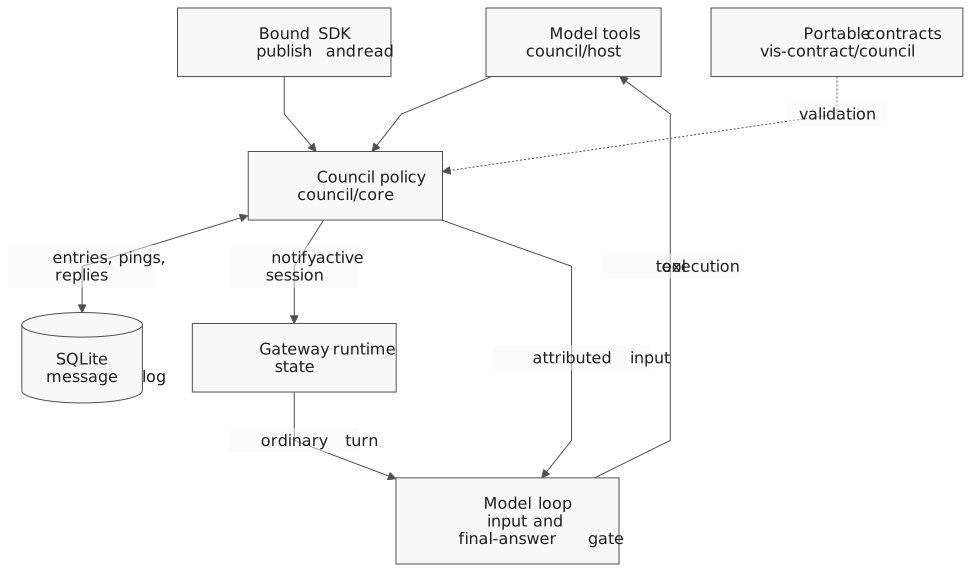
Local Council stores messages and reply relationships in SQLite. Rooms stores shared traffic in the relay database. The gateway tracks active sessions and refreshes room presence. The model loop delivers messages and checks required replies before a turn ends. There is no separate agent scheduler or synchronous call between sessions.
See also
- Council API — publish, read and manage rooms from your own program.
- Configuration — persistent feature toggles.
- Python sandbox — host tools and session context.
- Running a gateway — gateway scope and authentication.